
Cooling energy efficiency standards and policies: Raising global ambition while lowering global temperatures

A look back at the Clean Cooling Collaborative’s ‘Policies and Standards’ portfolio

As global demand for cooling soars, the energy efficiency of air conditioners and refrigerators will play a vital role in preventing run-away energy use and GHG emissions from the cooling sector. Energy efficiency standards, labels, and other policies are needed to drive the market towards the most energy-efficient appliances. 

The growing demand for cooling 

Globally, there are around 2 billion air conditioning units currently in operation. We expect this figure to roughly triple by 2050. If this prediction from the International Energy Agency (IEA) is correct, it’s the equivalent of 10 new air conditioners being sold every second for t he next 30 years 

Space cooling (e.g., air conditioning) is already one of the leading drivers of rising electricity demand in buildings, accounting for nearly 20% of the total electricity used in buildings, but electricity demand for cooling in buildings could increase by as much as 40% globally by 2030 if we don’t make major improvements to the efficiency of cooling equipment. 

Apartment building in Hong Kong, China with countless air conditioners
Energy efficiency standards for air-conditioning could dramatically reduce the energy demand from cooling.


Appliances with greater energy efficiency use less electricity, which helps reduce the greenhouse gas (GHG) emissions coming from power plants. This is critical if we’re to limit global warming to 1.5°C. It also reduces the strain we’re putting on our energy systems, which will help support the global transition to clean energy and limit the occurrence of power outages.

While high-performance air conditioners (ACs) already exist and are available on today’s market, consumers aren’t choosing to buy them. According to IEA, “the average efficiency of air conditioners sold today is less than half of what is typically available on the shelves – and one third of best available technology.”  

And it’s not only consumer choices that are an issue, even the most advanced air conditioners on the market are not efficient enough. 

What we need is for manufacturers to bring super-efficient cooling appliances to the market as soon as possible, and for consumers to buy them. To achieve this, governments must work to encourage and support innovation from the private sector and demand from consumers. 

Our cooling efficiency standards, labels, and policies 

Since 2017, the Clean Cooling Collaborative (CCC) has been supporting ambitious countries with the integration of energy efficiency into their efforts to reduce the use of super-polluting refrigerants like hydrofluorocarbons (HFCs) as part of implementing the Kigali Amendment to the Montreal Protocol. 

K-CEP Phase 1 Impact Report cover
Download our Phase I Impact Report to learn more.

A major part of this work has been promoting national and regional energy efficiency standards, policies, and other programs to achieve major reductions in GHG emissions from cooling, with a focus on room air conditioners[1]According to IEA, 70% of AC units currently in operation around in residential properties. (RAC) and household refrigerators and freezers. 

Alongside our implementing partners, we have supported the development and implementation of policies, standards, and programs in 35 countries. Together, these countries represent high potential for energy savings, good geographic spread, diverse market conditions (e.g., manufacturing and importing economies), and a sufficient level of capacity for implementation. 

This work has included: 

  • Minimum Energy Performance Standards (MEPS), which establish a minimum energy efficiency level for appliances, thereby removing the most inefficient products from the market place;
  • Energy labels, which help consumers identify products of higher efficiency and environmental performance;
  • Compliance and awareness programs, which support the implementation of MEPS and labeling programs;
  • Financial initiatives like rebate programs, which encourage consumers to buy products of higher efficiency; and 
  • Demand aggregation programs such as buyers’ clubs or public procurement programs, which encourage manufacturers to produce more products of higher efficiency while bringing down purchase prices. 

Another important part of our work, and key to ensuring the success of implemented policies, standards, or programs, has been understanding the local context. We’ve worked alongside E3G, an independent climate change think tank, to build country-specific political and economic awareness into all policy-relevant strategies. 

MEPS and labels 

According to IEA, the energy performance of ACs could be improved by 50% with the introduction of efficiency standards. This would also help put cooling on track with the Net Zero Emissions by 2050 Scenario. When paired with other sustainable cooling approaches, such as efficient passive cooling and natural refrigerants, we could avoid becoming reliant on and locked into inefficient cooling appliances for the decades to come. 

Despite their effectiveness, many countries still have weak, or even no MEPS for cooling technologies, as compared to global best practice.   

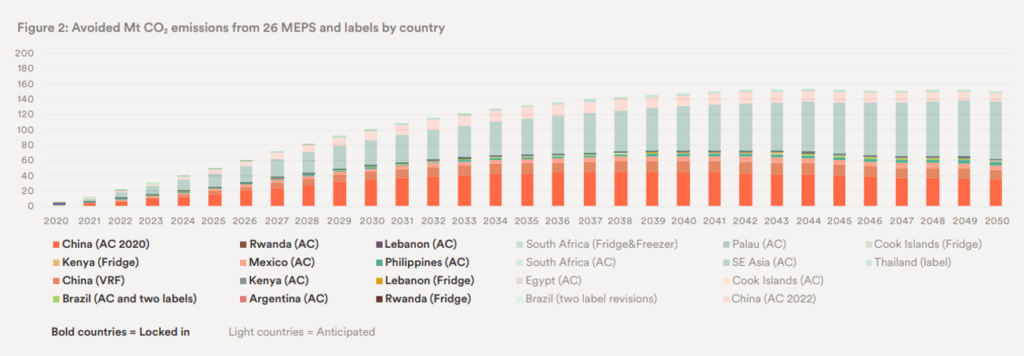
During the first four years of our work (2017-2021), we supported the development and implementation of 15 AC-related MEPS, as well as six refrigeration MEPS, and five AC labels[2]Of these 26 MEPS and labels, 14 have been ‘locked in’, i.e., have been secured through law, adoption, and/or implementation. The remaining 12 are waiting to be formalized and are therefore considered ‘anticipated’. . Once fully implemented, IEA estimates that these 26 MEPS and labels could avoid just over 3 gigatons (Gt) of carbon dioxide (CO2) by 2050[3]The emissions reduction from the 14 ‘locked in’ standards is over 1.6 Gt CO2 by 2050. The remaining 12 ‘anticipated’ policies are on track to deliver an additional emissions reduction of just over 1.8 Gt CO2 by 2050.. 

Graph showing the mitigation potential of K-CEP Phase I MEPS and labels
MEPS and energy labels can offer significant emissions reductions potential.


The expected electricity savings resulting from implementing the 26 MEPS and labels would be worth around $805 billion in reduced electricity costs to consumers cumulatively through to 2050. This doesn’t even capture the significant additional savings that utility companies can realize on the generation and delivery side as a result of reduced electricity demand from cooling. 

Across these standards and labels, the largest potential impact comes from the second stage of China’s RAC MEPS once it’s locked in later this year. Over the past few years, China’s domestic AC market has undergone a rapid transformation, having shifted away from inefficient, fixed-speed ACs and toward efficient, variable-speed ACs. As of July 2021, fixed-speed ACs accounted for only 2% of the domestic market, with variable-speed ACs making up the rest. 

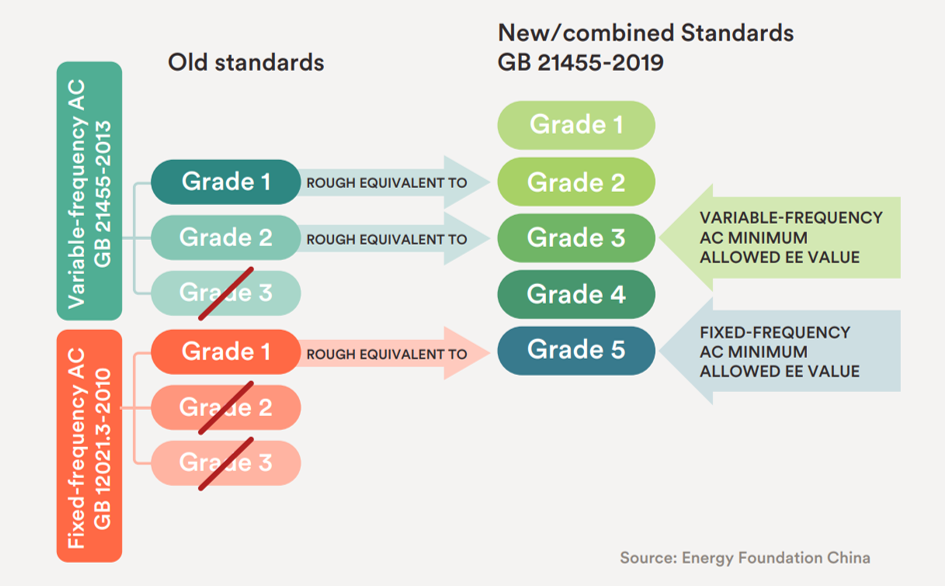
A diagram explaining China's RAC MEPS.
China’s 2020 RAC MEPS classifications compared to previous standard.


The second stage of China’s MEPS will eliminate current Grade 4 and Grade 5 ACs from the market. This will result in moving the entire of the Chinese market away from inefficient single-speed units to efficient variable-speed units. As the global leader in the production of RACs, China’s transition to more efficient cooling appliances sets an important benchmark for other countries and regions. 

China’s RAC MEPS was developed in conjunction with the Model Regulation Guidelines for Energy-Efficient and Climate-Friendly Air Conditioners from the United Nations Environment Programme’s (UNEP) United for Efficiency (U4E) initiative. These model regulations are a guidance tool for governments that are considering a regulatory framework for appliance energy efficiency and low-GWP refrigerants. The guidelines aim to accelerate the adoption of robust efficiency standards and labels where they don’t already exist, and to raise the ambition of outdated policies. 

In addition to the model regulation for air conditioners, we have supported the development of model regulations for energy-efficient and climate-friendly household refrigerators and freezers and commercial refrigeration equipment. There’s an ongoing effort to deploy these model regulations globally, with several countries adopting them outright and others using them as an example of best practice when formulating their own policies. 

HFC phasedown policy 

In close coordination with others, we’ve helped support major strides in HFC regulation, in particular in the United States (US), with the passage of the American Innovation and Manufacturing (AIM) Act. This regulatory act gives the US Environmental Protection Agency (EPA) the authority to regulate HFCs.  

The AIM Act requires an 85% phasedown in HFC supply over the next 15 years and brings the US in line with the Kigali Amendment, which is the global agreement to phasedown the use and production of HFCs over the coming decades. 

From this monumental and collaborative effort comes a series of rulemakings that are currently underway. 

What next for Clean Cooling Collaborative? 

Over the coming years, CCC — with a focus on China, India, Southeast Asia, and the US — will continue to work to raise the ambition of MEPS and labeling programs. These regions a will be responsible for about 75% of GHG emissions from stationary AC in 2050.  

Building on the success of existing model regulation guidelines, we will be working with U4E and its partners to development additional guidance for off-grid refrigeration and ceiling fans, both of which are vital for improving access to efficient cooling in under-served communities. 

We will also ramp up our involvement in HFC policy, helping countries move beyond the Kigali Amendment and drive low-GWP (global warming potential) refrigerants to the market.  

By helping governments, businesses, and consumers step up, we can collectively raise cooling efficiency standards, take stress off the electric grid, and transform markets so that efficient, clean cooling is accessible and affordable to all. 


This blog is part of a series looking back at the impact of our Phase I projects. Other blogs include a review of our finance portfolio, our access portfolio, and our efficiency portfolio.

Show me the money: Financing the transition to efficient, climate-friendly cooling for all

A look back at the Clean Cooling Collaborative’s ‘Finance’ portfolio

During the summer of 2021, it seemed like every week I read a newspaper headline about a new heat wave taking hold in a different part of the world. According to the experts, 2021 wasn’t an anomaly, with extreme heat events set to become a regular occurrence. News like this, in addition to rising global incomes and urbanization rates, is why cooling demand is expected to triple by 2050. Unfortunately, today’s cooling technologies (e.g., air conditioners and refrigerators) consume massive amounts of energy and contain super-polluting greenhouse gases (GHGs) called hydrofluorocarbons (HFCs). Cooling is already responsible for more than 7% of global GHG emissions and the projected rise in cooling demand over the next thirty years is expected to result in a two-fold increase in cooling-related emissions over the same time period.

It’s not a case of simply curtailing demand to cut emissions; access to cooling is vital for sustainable development, particularly relating to health and food systems. As global temperatures rise, we’ll need more cooling to maintain human comfort, health, and productivity, as well as to preserve food and medicines. If we’re to meet global cooling needs without exacerbating the climate crisis then we need to ensure that future cooling solutions are energy efficient and climate friendly. Achieving this is crucial for international agreements like the Paris Agreement, the Kigali Amendment to the Montreal Protocol, and the Sustainable Development Goals. 

Money talks 

Financing efficient cooling for all will require significant investment. While the total price tag is not yet known, the cost of inaction, as well as potential cost savings, are quite persuasive. 

According to the Economist Intelligence Unit (EIU), expanding electricity capacity to meet the growing demand for cooling will cost around US$4.6 trillion over the next decade. And according to the International Labour Organization (ILO), 1.5°C of global warming by 2100 would result in the loss of 2.2% of working hours (or 80 million jobs) by 2030, at an equivalent cost of US$2.4 trillion. These figures are by no means exhaustive and they don’t even begin to factor in other costs like impacts to human health, loss of life, and impacts on food supply, but they should go some way in convincing stakeholders to act.

In terms of what we have to gain by investing in the transition to more efficient cooling, we could reduce the cost of the renewable energy build out by up to US$3.5 trillion by 2030. It could also speed up the transition to net-zero emissions by eight years

Financing cooling efficiency is a big opportunity, with the super-efficient cooling equipment market estimated to be worth US$135 billion. The EIU estimates that the rising demand for cooling could drive market value to almost US$170bn in 2030.

Unlocking finance for clean cooling 

What stands in the way of financing the transition to clean cooling? One major barrier is that there are relatively few examples of financing mechanisms that demonstrate how to support efficient, climate-friendly cooling. If we’re to mobilize the necessary finance at speed and scale, we need demonstration projects across a range of geographies that use different applications and financing mechanisms. Dissemination of lessons learned and best practices is also needed to raise awareness of funding opportunities and to mobilize capital from new investors. 

Another issue is the sheer scale of the funding needed. It’s unlikely that any one stakeholder group will be able to support the transition alone. We need collaboration across philanthropy, the public sector, and the private sector to maximize potential impact. As an initiative of a philanthropic organization, we are particularly interested in the role that grantmaking can play in kick-starting the necessary finance.

Since 2018, we’ve issued US$10 million in grant funding for work on cooling finance. As of 2021, we estimate that this money will mobilize an additional US$600 million for initiatives that cost-effectively steer consumers and institutions towards more efficient, climate-friendly cooling solutions.

In addition to the six grants that fall under our finance portfolio, we’ve supported multiple grantees under other portfolios to prepare projects for finance. We’ve partnered with a range of capital providers to pilot innovative approaches to unlock finance for efficient, climate-friendly cooling across different geographies. Our projects have focused on a broad range of applications, including air conditioning and refrigeration across residential, commercial, industrial, and transport sectors, as well as supporting integrated and passive solutions like cold chains and cool roofs. We’ve provided targeted technical assistance grants to mobilize the capital needed to integrate energy efficiency improvements with the transition to low global warming potential (GWP) refrigerants. 

Projects have included: 

  • Supporting innovative consumer financing initiatives to help consumers overcome the higher upfront cost of energy-efficient cooling appliances. We partnered with the United Nations Environment Programme (UNEP) and the Basel Agency for Sustainable Energy (BASE) to develop on-bill and on-wage financing initiative through which customers can purchase an efficient, climate-friendly air conditioner and/or refrigerator1 with finance from a commercial bank. Customers then make repayments via their utility bill or salary deduction. See ECOFRIDGES and R-COOL for more information. 
  • Promoting green public procurement to help national and local authorities reduce the climate impact of their cooling systems while also stimulating the adoption of clean technologies and providing manufacturers with market certainty. We partnered with GIZ (Germany’s development agency) to develop a public procurement program in Bangladesh and UNEP for a district cooling project in Egypt. 
  • Catalyzing bank finance to fund clean cooling projects. For example, development banks providing finance to governments for public programs like cold chain development or passive cooling projects, or commercial banks offering finance to private entities like manufacturers to fund production of efficient appliances or developers to fund clean cooling projects. 
  • Supporting innovative business models like cooling-as-a-service (CaaS) where consumers pay for cooling on a per-unit basis rather than investing in the cooling equipment. The service provider owns, maintains, and covers all operational costs of the cooling system. Through this model, the service provider is incentivized to use the most efficient equipment. Energy Service Companies (ESCOs) provide a similar service with different contractual models that apportion costs between user and provider.  

Our finance portfolio has been a lab for action at scale and this work is proof that finance can influence institutions, build on policies and standards, develop supply chains, and raise awareness. We’ve catalyzed action and assisted in the implementation of projects that will result in additional on-the-ground investment in clean cooling, demonstrating how philanthropy can mobilize finance at scale.

More details about these projects, key challenges, and lessons learned can be found in a review of our Phase I finance work and its executive summary, produced in collaboration with the Carbon Trust.

What next?  

It’s undeniable that global cooling demand is high and that it’s on the rise. It’s also undeniable that we need to find ways to ensure demand is met with minimal impact to our climate. The above examples demonstrate the viability of different approaches to financing the provision of clean cooling solutions.

So, where next for the Clean Cooling Collaborative? Armed with this success and experience, we’re exploring how to replicate these approaches in different geographies. We’re also looking at how we can integrate finance more holistically across all of our work so that we can build on our strong foundations and amplify philanthropy’s impact. 


This blog is part of a series looking back at the impact of our Phase I projects. Other blogs include a review of our policies and standards portfolio, our access portfolio, and our efficiency portfolio.

Million Cool Roofs Challenge: Local Champions for a Global Movement

Cooling is essential to modern life. Whether it’s refrigerating food and vaccines along the supply chain, or keeping people cool in their homes, schools, or places of work, we need cooling to ensure quality of life and productivity. Yet somehow, over 1 billion people around the world currently lack access to cooling. This needs to change.

With the ultimate goal of accelerating access to affordable, sustainable cooling, the Million Cool Roofs Challenge was launched in 2019 to rapidly scale up the adoption of ‘cool’ roofs in developing countries where temperatures are high and access to cooling is low.  

Cool roof installers test different coatings to assess effectiveness in Nacajuca, Tabasco state, Mexico. (Credit: Jasón Sosa Gomez, Échale)


The Challenge an initiative of the Clean Cooling Collaborative (formerly K-CEP), Global Cool Cities Alliance, Sustainable Energy for All (SEforALL), and Nesta Challenges  awarded grants of $125,000 to 10 teams across the world to test different approaches and models to scaling up cool roofs in their countries. The team that demonstrated the most effective, sustainable, and scalable model for stimulating rapid deployment of cool roofs would win the Challenge’s final prize of $750,000. 

Cool roofs for cooler buildings and a cooler planet 

Cool roofs are often considered a “win-win” strategy for climate action and sustainable development due to their simplicity, cost-effectiveness, and ease of adoption, with relatively inexistent drawbacks. 

Workers apply solar-reflective coating to Lycée Delafosse in Dakar, Senegal. (Credit: Cool Roofers Senegal)


By applying a solar-reflective coating to a building’s roof, less of the sun’s radiation is absorbed by the building, which can reduce its internal temperatures by 2-3°C. When deployed across a whole community, cool roofs can reduce local ambient temperatures and help lessen the urban heat island effect. In addition to increasing thermal comfort for the billions of people who do not have the economic means to access mechanical cooling options (e.g., air conditioning, fans, etc.), cool roofs can help reduce the need for mechanical cooling, in turn reducing energy demand and cutting greenhouse gas emissions. Further, the deployment of reflective materials creates sustainable job and skills opportunities for low-skilled workers in both rural and urban settings. 

One million cool roofs 

To date, over 1.1 million square meters of new cool roofs have been installed by the Challenge’s 10 teams, despite many obstacles brought on by the Covid-19 pandemic. That’s an area equivalent to 250,000 small household rooftops.

As the Challenge comes to an end, teams have made some fantastic progress and seen some promising results. Most teams have reported indoor temperature reductions of at least 2°C, with some teams seeing temperatures drop between 4.4°C and 10°C. They’ve also helped to create hundreds of training and job opportunities in local communities; reduce cooling demand and realize energy savings; and boost thermal comfort for building occupants like school children, hospital patients, and factory workers. 

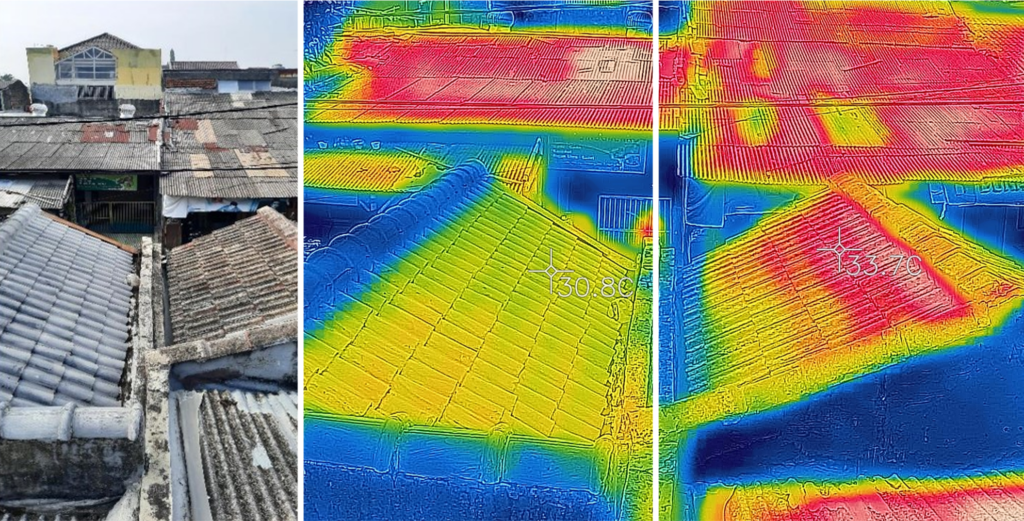
Example of how reflective coatings can reduce a roof’s absorption of the sun’s energy. A ‘cool roof’ (middle) has a surface temperature of 30.8°C, while an uncoated roof (right) has a surface temperature of 33.7°C. (Credit: Cool Roofs Indonesia)


Possibly the most important outcome of the Challenge has been the creation of a lasting legacy in participating countries and beyond. The competition has helped build a foundation for longer-term transformation ranging from raising awareness of cool roofs and developing local and regional production/supply chains, to changing building practices and influencing government policy like building codes and cooling action plans.

It’s encouraging to know that the impacts of the Challenge will be felt long after it ends.

And the winner is… 

Due to the effectiveness of their project, their collaborative approach, and their plans for scaling up their work, Cool Roofs Indonesia has been selected as the winning team of the Million Cool Roofs Challenge and its $750,000 prize.

During the Challenge, the team installed cool roofs on 70 buildings across 15 cities in Indonesia, including 36 low-cost housing units, 10 schools, two factories, and one orphanage. In total, the team estimates that 10,250 people will benefit from the newly installed cool roofs.  

Aerial shot of an orphanage in Pontianak, Indonesia with a patchwork of cool roofs to improve thermal comfort for the children. (Credit: Cool Roofs Indonesia)


The Indonesian team saw some of the Challenge’s most impressive reductions in indoor temperatures. At one industrial site, indoor temperatures dropped by 10.7°C (from 40°C to 29.7°C) following the application of the cool roof coating. And at an elementary school, indoor temperatures were reduced by around 3°C (from 36°C to 33°C).

Indonesia is home to over 46.5 million people who are at high risk from a lack of access to cooling. Due to a combination of insecure electricity supply, poor quality housing, and unaffordable air conditioning, many within these communities will face heat stress on a daily basis. The temperature reductions being seen during the Challenge could have a significant impact on the lives of Indonesia’s lower-income communities.

What next for cool roofs in Indonesia? 

During the Challenge, Cool Roofs Indonesia helped create and support over 100 manufacturing and installation jobs by establishing its own production capacity. The team hopes to boost employment opportunities further by working to scale up the local production of cool roof coatings as the program moves into its next phase. Through scaling up local production, they expect to reduce the cost of producing cool roof materials by around 20%, making cool roofs even more accessible.

As a part of their efforts to boost local production, Cool Roofs Indonesia is planning to set up the country’s first testing facility for solar reflective materials to ensure product quality and performance. They also plan to produce academic research to further highlight the importance and effectiveness of cool roofs in the Indonesian context.

The team has plans to work alongside government ministries to build on the successes of their Million Cool Roofs Challenge project and develop policy (e.g., national standards, building codes, etc.) that will facilitate the continued adoption of cool roofs across the country.

According to Beta Paramita, Assistant Professor of Architecture at Universitas Pendidikan Indonesia and Project Manager of Cool Roofs Indonesia, there are two key factors for deploying cool roofs at scale: ensuring you have a stable production and supply chain; and securing the support of trusted voices within the local context (e.g., academia). Beta’s advice fits nicely with the team’s approach both during the Challenge and for the next phase of their project. 

While the Challenge has come to an end, the real challenge is just beginning. We’re excited to see how Cool Roofs Indonesia and the other nine finalists carry the Million Cool Roofs legacy forward to help make clean cooling accessible to all.

On March 4 we hosted a webinar to celebrate the conclusion of the Million Cool Roofs Challenge. We were joined by most of the Challenge teams, as well as some of the partner organizations. You can watch a recording of the webinar here.

Cooling at COP26: What did and didn’t happen?

With COP26 now behind us, we wanted to take a step back and look at what cooling commitments were (and weren’t) made and what these announcements mean for the cooling industry and climate action in general.

A lot of pressure was placed on this year’s COP, and rightly so. Pre-COP commitments – as included in countries’ Nationally Determined Contributions (NDCs) – had set us on a path to a global temperature rise of 2.7°C by the end of the century, which is well over the internationally-agreed limit of 1.5°C and will result in catastrophic impacts around the world. In order to ensure that we put ourselves on the right track, we needed to see greater ambition from countries, cities, businesses, and other stakeholders.

Ahead of COP26, we set out a somewhat ambitious (albeit reasonable) ‘to do’ list for cooling stakeholders, which detailed what commitments we hoped to see being made at the conference in Glasgow. Desired actions included adopting more stringent minimum energy performance standards (MEPS); ratifying the Kigali Amendment; developing cooling action plans (national and local); doubling down on the energy efficiency of buildings and products; adopting better urban planning; joining the Race to Zero; and boosting investment in research and development, as well as cooling initiatives.

With this year’s COP now behind us, what commitments were made, what is missing, and what does it mean for both the cooling community and the world as a whole?

Cooling at (and around) COP26

The two weeks of COP26 went by in a flash. Each day came with new commitments that covered a range of topics, including deforestation, methane emissions, finance, and coal to name a few. In addition to these advances, the Glasgow Climate Pact also includes plans to revisit emissions-cutting pledges (e.g. NDCs or national long-term strategies) next year to try to keep the 1.5°C target reachable.

A number of cooling-specific announcements were made throughout the conference. And while they may not have made the frontpages, they mark significant progress in our fight against climate change.

At the national level:

  • 14 SEAD (Super-efficient Equipment and Appliance Deployment) Initiative member countries – Brazil, Chile, Columbia, Denmark, Germany, Ghana, India, Japan, Korea, Nigeria, Sweden, United Kingdom, Indonesia, and South Korea – have signed up to the initiative’s Product Efficiency Call to Action. This is the largest ever government commitment to double product efficiency globally by 2030, with a focus on air conditioners, refrigerators, motors, and lighting (which account for 40% of global electricity demand).
  • The UK Government committed £12 million ($16 million) to support rapid progress on reducing hydrofluorocarbons (HFCs) and for the adoption of energy efficient cooling solutions. They also launched their Urban Climate Action Programme, which will support cities and regions in developing countries to decarbonize.
  • France launched a leadership guide on efficient, climate-friendly cooling, in partnership with the UN Environment Programme’s Cool Coalition and Climate and Clean Air Coalition.
  • A new Champions Group on Adaptation Finance – launched by Ireland, the Netherlands, Denmark, Sweden, the UK, and Finland at the UN General Assembly in September – has expressed clear political commitment to work with developing countries to increase levels of adaptation finance. Through this work, these six governments have pledged to increase the total share of climate finance spent on adaptation and resilience, particularly for Least Developed Countries (LDCs) and Small Island Developing States (SIDS). Initiatives like this will mobilize resources to help tackle extreme heat.

At the city level:

  • The Cool Coalition, in partnership with RMI, the Global Covenant of Mayors, Mission Innovation, and the Clean Cooling Collaborative launched its Sustainable Cooling Handbook for Cities. So far 16 cities have committed to use the handbook.
  • Seville, Spain announced plans to name and rank heat waves.
  • Athens, Greece announced plans to categorize heat waves from summer 2022.
  • Miami-Dade County in the United States announced plans to declare a ‘heat season’ (May 1 until October 31) from 2022, offering shelter space and focusing on vulnerable populations. They will also offer an extreme heat toolkit, run public awareness campaigns, and include heat as a key part of the county’s disaster planning
  • Over 1,049 cities have committed to the Race to Zero. This represents some 722 million people and 1.4 gigatons of CO2 each year. Most cities’ commitments include creating resilient and renewable energy systems, developing net-zero carbon buildings, and making food systems more sustainable – all of which would require action on cooling.

From the private sector:

COP26 also provided a stage for this year’s Ashden Awards, where Mahila Housing SEWA Trust won the award for Cooling in Informal Settlements (sponsored by ourselves and ClimateWorks Foundation) and Solar Freeze Ltd won the award for Humanitarian Energy.

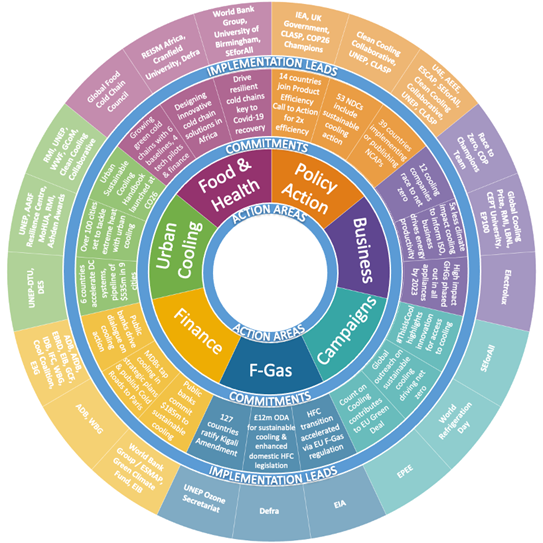
A number of other cooling commitments were made in the run up to COP26, setting the stage nicely for others to take similar steps. Highlights include committing to bring super-efficient air conditioners to market, developing national cooling action plans, mapping pathways to sustainable cooling, and committing sizable amounts of funding to support clean cooling globally. The Cool Coalition’s Cooling Commitments Compass (see below) gives an overview of recent announcements and updates from around the world of cooling.


Moving beyond COP26: what next?

Looking over the list of recent pledges, we are encouraged and optimistic that we’re on the right path, but we can’t stop there. More ambitious commitments and timely action is needed to secure the change necessary to reduce cooling’s climate impact and limit global warming to 1.5°C. So what do we want to see in 2022?

One major opportunity is for governments to commit to efficient, climate-friendly cooling in their revised NDCs or long-term strategies in 2022 as part of the Glasgow Climate Pact’s agreement to ‘revisit emissions-cutting plans next year’. By adopting clean cooling solutions, governments can simultaneously cut greenhouse gas emissions and help build resilience to our changing climate. Efficient, climate-friendly cooling’s mitigation and adaptation potential should not be underestimated. One action that could (and should) be included in a government’s strategy is to develop and implement a national cooling action plan, which can be done using the National Cooling Action Plan Methodology from the Cool Coalition and partners.

Another priority is for national governments to double down on improving the energy efficiency of cooling systems by committing to SEAD Initiative’s Product Efficiency Call to Action. It’s promising to see governments from some key cooling countries (e.g. India and Indonesia) having already endorsed the initiative, while other nations (e.g. the US, China, and the EU) are yet to demonstrate their commitment. We’re calling on all G20 members to have answered SEAD’s call to action by COP27 in Egypt. Other stakeholders can take similar action through joining EP100.

In support of national action (or absence thereof), cities and regions can show leadership in this sphere by using the guidance set out in the Sustainable Cooling Handbook for Cities to help cut emissions and build resilience. They can also join international action networks like the Race to Zero and Cool Coalition. Similarly, cities can follow Seville, Athens, Miami, and Freetown in their efforts to raise awareness of and protect residents from the dangers of extreme heat.

A major component of unlocking future progress is finance. Funding the clean cooling transition will require sizable investment from public, private, and philanthropic sources. The recent financial commitment from the Green Climate Fund (via the World Bank) is a great starting point, and demonstrates the importance of funding for efficient, climate-friendly cooling. To draw further attention to the need for more finance, the Cool Coalition is aiming to form a Working Group on Finance among their members in 2022, building on the Multilateral Development Bank Working Group that was co-convened with E3G and bank champions  in 2021.

The key message we want to deliver is one of optimism. We are encouraged by the announcements made at COP26 and to see the range of stakeholders that are taking action to support the global transition to efficient, climate-friendly cooling. Unfortunately, the commitments being made aren’t enough to ensure net-zero cooling by 2050. We need to go further and go faster. We need all stakeholders – particularly those in regions where cooling demand and emissions are on a steep growth trajectory i.e., the US, China, India, and Southeast Asia – to make and follow through on ambitious commitments. We need to double down on the energy efficiency of cooling systems; we need to transition to refrigerants with ultra-low global warming potential; and we need to adopt passive cooling techniques that reduce the need for mechanical cooling (while also building resilience to heat). To protect people and the planet, we need action now.

Leave no one behind: Efficient, climate-friendly cooling for ALL

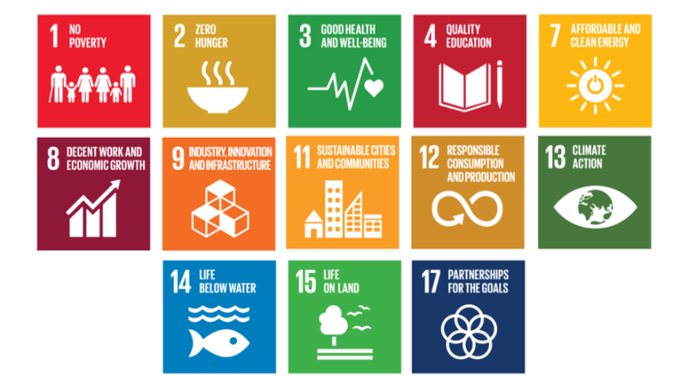
‘Leave no one behind’ is the central promise of the UN Sustainable Development Goals (SDGs), yet billions of people lack access to efficient, climate-friendly cooling. We simply cannot achieve the SDGs, be it poverty reduction, zero hunger, better health and wellbeing, sustainable cities, or climate action, without securing universal access to clean cooling. Social inequity is a significant barrier to cooling access, with marginalized and low-income communities being both the most vulnerable to extreme heat and the least likely to be able to access thermal comfort. This needs to change, but how?

“It was getting hotter,” the novel begins. “…It felt dangerous even to talk, one would overheat. And what was there to say anyway? It was too hot to think.”

In his 2020 sci-fi novel Ministry for the Future, Kim Stanley Robinson opens with a harrowing account of a deadly, extreme heat wave that strikes India in the near future. It is hard to read. And it becomes even more excruciating when you realize what reads like science fiction is radically becoming a present-day reality for many.

The inequities of cooling access

Over 1 billion people across our warming world experience the worst impacts of extreme heat due to lack of access to cooling. In Bangladesh, the ongoing climate crisis has led to the displacement of millions of people, many of whom often end up in the slums of over-crowded cities, where informal housing structures are typically assembled from high heat-absorbing materials like corrugated tin or iron. In Kenya, Nairobi’s informal settlements have seen temperatures that were up to 4.8°C warmer than the city’s official weather station nearby. And this is not just an issue in developing countries; in the United States, intensified extreme heat waves disproportionately affect low-income, BIPOC communities, and other marginalized groups. According to a recent story in Time, in the U.S., how you experience the heat “depends on your race and your zip code”.

As we race to curb the greenhouse gas (GHG) emissions of the cooling sector, it is important that we also address the cooling access gap and build resilience to protect the most vulnerable from rising temperatures.

Making ‘cooling for all’ a reality

Earlier this week at the Cooler Homes, Stronger Communities COP26 side event, we heard from frontline innovators such as Mahila Housing Trust about how grassroot groups and local organizations are delivering cooling equity through championing passive cooling solutions from the ground up. Echoing this bottom-up approach are the ten teams of the Million Cool Roofs Challenge (MCR), which are delivering solar reflective “cool” roofs as a key passive cooling solution in countries where there is an acute lack of access to cooling. In Cote D’Ivoire, two social enterprises – Social Tech and MonArtisan – tapped into the strength of their own communities to unlock the benefits of cool roofs. The team mobilized schools and the surrounding communities to recycle plastic waste and sell it on to recyclers, thereby generating the funds to deploy cool roofing in their communities. In Kenya, MCR finalist Steam Plant Ltd focused on installing cool roofs in two major informal settlements in Nairobi, improving learning, working, and living conditions for over 7,800 inhabitants.

And we firmly believe that grassroot climate heroes should not be fighting this fight alone. We need cooling equity champions from governments, businesses, and organizations small and large to join force. In addition to scaling up localized, low-cost passive cooling solutions, multiple strategies should be applied to bridge the cooling access gap:

  • Improving the energy efficiency of low-cost cooling appliances such as fans, through higher efficiency standards to cut operational expenses for low-income households and thereby making thermal comfort more accessible.
  • Introducing consumer-targeted financial incentives such as on-bill financing and rebate programs, to enable low-income communities to access to a range of efficient, climate-friendly mechanical cooling appliances, which often require a higher upfront cost compared to inefficient and polluting models.
  • Providing financial assistance for operational costs of cooling e.g., energy bills. We need to look beyond just the delivery of efficient and clean cooling products to also help low-income households address challenges they face during the operation phase.
  • Developing city-wide sustainable cooling action plans, including equitable infrastructure development (e.g., green space) and initiatives that protect vulnerable populations during times of extreme heat (e.g., cooling centers).
  • Utilizing more passive cooling techniques such as reflective building materials, increased greenspace, and improved shading and ventilation, to reduce households’ reliance on more costly mechanical cooling.
  • Addressing the cooling needs of at-risk communities across thermal comfort, food security, and health services to bring forth a comprehensive range of sustainable cooling solutions.

In this collective mission to enhance cooling equity, it is not only what we do that matters but also how we do it. As the key stakeholder in this equation, we must ensure that the voices and ideas of local communities are heard throughout the whole process. Governments, international organizations, and sustainable cooling businesses must work alongside frontline communities to build solutions with those who are most impacted, not for them.

If we’re to ensure efficient-climate-friendly cooling for all, as required for the achievement of several climate and development goals, then we must address the issue of social equity. Without cooling equity, many, many people will be left behind.

Cooler cities, cooler people, cooler planet: The ‘triple win’ of sustainable urban cooling

Cities are at the forefront of the climate crisis; they’re heating up at twice the average global rate and they’re a major source of the greenhouse gases (GHGs) that are warming our planet. How can sustainable urban cooling solutions help local governments create cooler cities and protect their residents from rapidly rising temperatures while also limiting further global warming?

As global temperatures rise, our cities are heating up at twice the average rate due to the urban heat island effect, a phenomenon by which human activities and the make-up of a city (e.g. high usage of concrete, steel, and glass, as well as diminished greenspace) create and capture heat, keeping temperatures high long after the sun’s gone down. By 2100, cities across the world could warm by as much as 4.4°C on average, which could be catastrophic for the health, wellbeing, security, and economic productivity of their residents. Even with 1.5°C of warming, 2.3 billion people could be exposed and vulnerable to extreme heat events. 

The need for increased access to cooling to avoid extreme heat in our cities is undeniable, and doing nothing is not an option. Unfortunately, conventional cooling solutions like air conditioners are typically energy-intensive and use refrigerants with a high global warming potential (GWP), compounding the problem further by producing the GHGs that are heating up the planet. 

Cities, with all their inhabitants, buildings, and infrastructure, are already responsible for more than 70% of the world’s global carbon emissions[4] Net Zero Carbon Cities: An Integrated Approach, World Economic Forum (2021) . Cooling appliances, such as air conditioners, are key drivers of emissions, with up to 10% of demand for electricity in cities used to compensate for the urban heat island effect. If we’re to have any chance of limiting global warming to 1.5°C, then cities need to achieve net-zero emissions by 2050. Clearly, continuing to cool our cities as we currently do is not an option. 

So how can we create cooler cities with solutions that doesn’t exacerbate the climate crisis? 

Sustainable urban cooling

Sustainable cooling solutions – i.e. solutions that are super-efficient, climate-friendly, and utilize low- or zero-carbon electricity – are essential if we’re to meet our climate and development goals, simultaneously. 

Solutions to avoid dangerous heat include urban green and blue infrastructure (e.g. tree cover and waterways), which can reduce ambient temperatures by multiple degrees; better building design (e.g. shading, better building envelopes, ventilation, and reflective materials) that can reduce the need for mechanical air conditioning; district cooling, because it can efficiently cool a large network of buildings; and cooling centers, which can provide much-needed thermal comfort and safety to vulnerable populations during times of extreme heat. 

And it’s not simply a case of improving the environmental performance of our cities’ cooling, it’s also about ensuring that access to cooling is equitable and reliable. More often than not, the impacts of urban heat are not evenly distributed, with lower-income and marginalized communities being both the most vulnerable and the least likely to be able to afford or access thermal comfort. For those with access to mechanical cooling, reliability of power supply can be compromised by high demand during heat waves leading to blackouts and knock-on effects on health, livelihoods, supply chains, and stability.

What we need is an integrated, whole-systems approach to accelerate the transition to sustainable urban cooling for all, and to ensure that potential benefits are maximized. In doing so, we can work to reduce temperatures at the city-level, reduce cooling demand at the building level through passive design and cool materials, and ensure that any remaining demand for mechanized cooling is met using efficient, climate-friendly technologies (e.g. super-efficient air conditioners that use ultra-low GWP refrigerants).

Supporting cities’ transition to sustainable cooling for all

Local governments that are looking to create cooler, healthier and more liveable cities are faced with a wide variety of options, so knowing how and where to start can be an overwhelming task. Luckily, there is a lot of information and support available to help cities transition to sustainable cooling for all.

The new Sustainable Cooling Handbook for Cities from the UN Environment Programme’s Cool Coalition, RMI, the Global Covenant of Mayors, Mission Innovation, and the Clean Cooling Collaborative, with support from WWF Cities, provides a framework for implementing sustainable cooling and extreme heat strategies at the city or district level for both developing and developed countries. In addition to recommending the development of a holistic, citywide cooling action plan, the guide showcases several interventions that can be implemented by city governments:

  • Developing heat-resilient urban design and infrastructure via urban planning, nature-based solutions, and cool surfaces can cut the urban heat island effect and reduce the need for mechanical cooling in buildings.
  • Implementing district cooling systems in densely populated urban areas can provide thermal comfort with significantly reduced climate impact.
  • Improving the energy and thermal efficiency of buildings through better design and construction not only reduces the urban heat island effect, but also provides thermal comfort within the buildings, which reduces the need for mechanical cooling.
  • Leading by example by ensuring all city-controlled assets (i.e. buildings, cooling equipment, and transport) are efficient and climate friendly. City governments must practice what they preach, and showcase successful models.
  • Advancing equity and cooling access through community-centric initiatives like cooling centres, heat alerts, wellness check programs, and community tree-planting. 
  • Raising awareness about urban heat and sustainable urban cooling among different communities is vital for success. Outreach activities could include guides and educational materials, demonstration projects, and behaviour change campaigns. 
  • Investing in capacity-building and training among city authorities and other key actors is necessary for the successful development, implementation, and enforcement of urban cooling initiatives.
  • Identifying and securing funding and financing sources is critical for the success of these interventions. There are a variety of options available for sourcing funds, including taxes, user fees, fines or penalties, official development assistance, public-private partnerships, and climate funds.

Many cities have also started to designate cooling champions to lead the charge against extreme heat, which just so happens to be one of the handbook’s recommended actions. So far, Miami (USA), Athens (Greece), and Freetown (Sierra Leone) have all appointed Chief Heat Officers (CHOs), and Seville (Spain) has recently announced that they will start to name and rank heat waves like other regions do tropical storms and hurricanes. And yesterday, at a COP26 side event, Mayor Daniella Levine Cava announced that from 2022, Miami will establish an annual ‘heat season’ that will run from May 1 until October 31. In addition to helping address urban heat in Miami, Athens, Freetown, and Seville, these announcements will also help to raise awareness of extreme heat as a global issue, encouraging other cities to follow suit. 

The time to act is now

If we are to limit global warming to 1.5°C, as committed to by national governments in the Paris Agreement, then we need cities to achieve net-zero emissions by 2050. And in order to achieve net-zero by 2050, cities need to take urgent action to decarbonize their buildings and infrastructure, and build resilience to protect residents from rising temperatures.

There’s a long road ahead of us, but there’s plenty of support available to cities, as well as other stakeholders, to secure the progress we need. Tools like the Sustainable Cooling Handbook of Cities are providing actionable guidance for cities to support the development of sustainable cooling initiatives that can cut emissions and provide relief from the heat. Networks like the Cool Coalition and the Extreme Heat Resilience Alliance, and campaigns like the Race to Zero and the Race to Resilience, are facilitating collaboration among stakeholders to stimulate ambition and drive change within urban heat, sustainable cooling, and beyond. 

For city officials looking to learn more about the threat of urban heat and how sustainable cooling can help protect people from extreme heat while supporting climate mitigation and adaptation efforts, there are a number of events taking place at COP26 that shouldn’t be missed. And the road doesn’t stop at COP26. Join the World Bank and partners on December 2nd for their ‘Making Cities Cooler with Nature’ webinar. And in 2022, the year of implementation, there will be more opportunities for cities and countries alike to highlight how they are taking action against extreme heat.

Our cities need clean cooling, both to protect urban communities from the deadly heat that is becoming all too familiar, and to mitigate the GHG emissions associated with cooling activities that warm our world even more. The world needs cities to act now.

A guide to cooling at COP26

With the long-awaited COP26 starting in just a few days, we wanted to let you know what cooling-related events are planned for the two weeks in Glasgow. From sustainable cities and cold chains, to energy efficiency and passive cooling, there are lots of great cooling events scheduled at COP26.

Please find a preliminary list of events below. We will update the list as new events are announced and details are confirmed. All times are GMT. 

We hope to see stakeholders from all around the world participate in discussions, announce new commitments to efficient, climate-friendly cooling, and demonstrate the leadership we need to achieve climate and development goals.


If you’re involved in a cooling-related event at COP26 and would like to add it to our list, please let us know.


Tuesday, November 2nd

Sustainable Cold Chain for the People, for the Planet: Addressing Climate Change, Hunger, and Energy

10:15-11:00 – Nordic Pavilion

Cool Coalition, SEforALL, and Clean Cooling Collaborative

Access to sustainable cold chains is an indispensable element for sustainable agricultural and rural development and reducing global emissions. This event will showcase the global status of cold chains and successful approaches to sustainable cold chains from countries and the private sector, with the goal to inspire accelerated action.

Watch the recording here.

Champion Mayors for Heat Action

15:30-17:00 – Resilience Hub

Atlantic Council

This session will feature mayors who have shown extraordinary global leadership in addressing extreme heat in urban areas. It will be an engaging discussion concerning extreme heat-related infrastructural issues within urban communities, including the accessibility of air conditioning, energy access, air pollution, and heat risk mitigation.

Watch the recording here.


Wednesday, November 3rd

Miti­ga­ti­on Po­ten­ti­al of F-Gas Banks Ma­nage­ment and Op­ti­ons for Mar­ket-ba­sed Ap­proa­ches

9:00-10:30 – IETA Business Hub (Virtual)

Green Cooling Initiative, GIZ, and the German Federal Ministry for the Environment, Nature Conservation and Nuclear Safety

Environmentally-friendly and energy-efficient cooling technologies with natural refrigerants are gaining ground, but as we move into the future, we must not forget the huge emissions stocks in our old cooling appliances. This virtual side event provides an overview on global F-Gas banks, potentials of banks management, and options for market-based approaches.

Watch the recording here.

Beat the Heat: Sustainable Urban Cooling for a Climate Proof Future

12:30-13:00 – Nordic Pavilion

Cool Coalition, RMI, Clean Cooling Collaborative, Global Covenant of Mayors, and Mission Innovation

The world’s cities are heating up at twice the global average rate due to urban heat island effect. Cities need to urgently adopt strategies to reduce heat at urban scale and cooling needs in buildings, serve cooling needs in sustainable and efficient ways. This session will showcase tools and solutions cities can use to tackle urban heat in sustainable and comprehensive ways, to protect the people and the planet alike. The Cool Coalition will launch the Sustainable Urban Cooling Handbook, a new tool that provides actionable guidance for cities to organize and prioritize action towards sustainable and equitable urban cooling.

Watch the recording here.


Thursday, November 4th

Panel Discussion on Product Efficiency: The World’s First Fuel – Making the Clean Energy Transition Cheaper, Easier and More Cost-Effective

12:00-13:15 – UK Presidency Pavilion 

SEAD Initiative, CLASP, IEA, UK BEIS, and Cool Coalition

This event will showcase how through the reinvigorated Super-Efficient Equipment and Appliance Deployment (SEAD) Initiative and the UK’s COP26 Product Efficiency Call to Action governments, business, NGOS and consumers are working to double the efficiency of four key appliances by 2030.

Watch the recording here.

Upscaling Energy Efficiency Financing – Identifying and Overcoming the Investment Gap

16:00-17:00 – Brussels Studio

European Commission (DG ENER), EEFIG, and Cool Up

This panel will discuss EEFIG’s recommendations to upscale energy efficiency investments and the related challenges and feasibility in Europe and beyond, including how energy efficiency financing schemes can be scaled up in the sustainable cooling transition. Special attention on sustainable cooling will be given with a focus on the Cool Up programme.

Register here.

Supporting Clean Energy Entrepreneurs

17:15-18:45 – Resilience Hub

CLASP, Efficiency for Access, IEA, ICF, and SEforALL

A just and inclusive energy transition, one that alleviates energy poverty and mitigates climate change, requires an understanding of the needs of local clean energy entrepreneurs. In this one-hour panel discussion, stakeholders will discuss the obstacles and solutions to promoting a thriving local entrepreneurship environment in the off-grid solar sector.

Watch the recording here.

The Ashden Awards 2021

18:00 – COP26 Green Zone & Online

Ashden 

Join Ashden as they reveal the exciting initiatives that can fire us towards a low-carbon future. They will announce this year’s award winners and premiere a film highlighting the personal journeys of nine inspiring pioneers. From clean and affordable energy to new jobs and green skills, the Ashden Award winners show the awesome potential of climate action.

Watch the recording here.


Monday, November 8th

Cooler Homes, Stronger Communities

14:00-14:45 – SDG7 Pavilion

Ashden, Clean Cooling Collaborative, and Cool Coalition

Soaring heat creates danger in homes and neighbourhoods around the world, and people already marginalized are at greatest risk. Communities and grassroots innovators are taking action – but how can those in power support cooler homes for all?

Watch the recording here (at 03:09:00).


Wednesday, November 10th 

Integrated Urban Climate Action Aligned to 1.5°C: Exploring overlooked opportunities

14:00-15:15 – WWF Panda Hub

WWF Climate

Watch the recording here.

Sustainable and Efficient Cooling for a Warming Planet: Challenges, Opportunities, and Solutions 

16:45-18:00 – Multimedia Studio 3, COP26 Blue Zone

Japan, OECC, Alliance for Responsible Atmospheric Policy, CCAC, and Cool Coalition

As the planet warms, the need for sustainable cooling for all is growing. This event examines how the cooling sector can improve climate outcomes through end-of-life disposal of hydrofluorocarbons (HFCs), improved efficiency, and increased speed and ambition to phase out high global warming refrigerants.

Watch the recording here.


Thursday, November 11th

Cooling: Concrete Options to Raise Ambition and Action – The Case of Cities

10:00-11:30 – French Pavilion

This side-event, organised by France, is an opportunity to highlight the climate impacts associated with the growing need for cooling (air conditioning and refrigeration), due both to the refrigerants used (mostly greenhouse gases) and to the energy consumption associated with the use of equipment.

Watch the live stream here.

(Green) Coo­ling as a Ser­vice 

12:30-14:00 – Online

GIZ Proklima and the German Federal Ministry for the Environment, Nature Conservation and Nuclear Safety

This online event will focus on one particular financing opportunity: Cooling as a Service (CaaS). The business model aims to enable clients to benefit from climate-friendly and energy efficient cooling technologies without the need of an upfront investment. Users pay for the cooling they receive, rather than the physical product or infrastructure that delivers the cooling.

Watch the recording here.

Be Bold: Sustainable Cooling for All

14:00-14:45 – SDG7 Pavilion

SEforALL and Cool Coalition

In a warming world, meeting our climate and sustainable development goals can’t be achieved without providing affordable, clean and climate friendly cooling solutions to address the needs of the most vulnerable. This side event will target policymakers and solution providers that are able to support increasing access to cooling through affordable, clean, and climate-friendly solutions.

Watch the recording here.

Empowering heat action at City Hall: The Chief Heat Officer

19:15-20:45 – Resilience Hub (Virtual)

Atlantic Council and the Extreme Heat Alliance

This session will feature the world’s first three Chief Heat Officers (CHOs) – city officials that plan and implement extreme heat-related policies and actions to protect the city’s population from heat risks. They will comment on the kind of challenges they face and share specific initiatives that are being undertaken in their cities.

Watch the recording here.

Sustainable cold chains: The missing link for sustainable development

Expanding global cold chains is vital if we’re to meet several of the Sustainable Development Goals relating to poverty reduction, food security, health and wellbeing, and climate action. That said, conventional cold chain technologies are energy intensive and harm our climate. So how can we improve and expand the global cold chain without exacerbating the climate crisis? Sustainable cold chains are the missing link.

Cold chains, which are the refrigerated portions of the supply chain, have always been an important aspect of modern life. For food, they help keep produce fresh, nutritious, and safe as it is moved from farm to fork, enhancing food security, reducing food waste, and boosting income for farmers. From a medical perspective, cold chains are crucial for the successful roll-out of immunization programs (such as for Covid-19), as well as the distribution of other life-saving medicines. Without a robust and unbroken cold chain, we can’t ensure the distribution of viable vaccines to the millions or billions of people who need them.

The importance of the cold chain

Every year, around 13% of the world’s food is lost due to a lack of effective refrigeration. This equates to 475 million tons of spoiled produce, which would be enough to feed around 950 million people. In a world where 811 million people are hungry and 2 billion people suffer from food insecurity, improving and expanding the cold chain would have a significant impact on global poverty reduction and other related development goals. 

This level of food waste results in the emission of an estimated 4.4 gigatons of CO2 equivalent each year (~8% total global greenhouse gas (GHG) emissions), of which, 1 gigaton of CO2 equivalent is thought to come from the absence or inefficiency of cold chains[5]Status of the Global Cold Chain: Summary briefing - Cool Coalition. In developing countries, where 90% of food waste happens along the supply chain, it’s estimated that some 470 million smallholders, farmers, and downstream value chain actors experience at least a 15% reduction to their income due to these losses[6]Net-zero cold chains for food - Carbon Trust and Clean Cooling Collaborative.

According to Sustainable Energy for All (SEforALL), around 2.7 billion people lack dependable access to vaccines as a result of insufficient cold chain infrastructure. It’s been estimated that more than 25% of some vaccines are wasted globally each year due to failings along the cold chain (e.g., temperature control and logistics). While this is problematic at any time, it’s particularly inadequate at a time when we need to ensure the equitable distribution of over 10 billion doses of Covid-19 vaccines to every corner of the world. Due to the nature of many of the Covid-19 vaccines, which require almost constant refrigeration, it’s likely that more than 85 of the world’s poorer countries will not have widespread access to Covid-19 vaccines before 2023. Not only does this delay directly threaten the health and wellbeing of a large portion of Earth’s population, it also makes it very difficult for global herd immunity to be reached, essentially putting everyone at risk.

The climate cost of cold chains

While we clearly need to take action to address these issues, it’s not quite as ‘simple’ as just expanding cold chains as they are. Conventional cold chain technologies typically use a huge amount of energy that generally comes from fossil-fuel sources; refrigerants that are often thousands of times more polluting than CO2; and transportation that runs off petrol and diesel, all of which is harming our climate. While not much data is available, it’s estimated that today’s global food cold chain infrastructure alone is responsible for around 1% of global CO2 emissions[7]James, S. J. & James, C. The food cold-chain and climate change. Food Res. Int. 43, 1944–1956 (2010).. And as global temperatures rise, it is likely that emissions from cold chains will also increase due to a greater need for cooling.

If we’re to expand cold chain coverage to ensure universal access without exacerbating the climate crisis, we must do so using a whole-systems approach with technologies that are energy efficient and climate-friendly, and use low-carbon transportation. We know that this is achievable, and we must accelerate action to support the transition to sustainable cold chain technologies. 

Improving and expanding sustainable cold chains

Cold chains, be they for food or for vaccines, are very complex systems, with lots of different stakeholders and lots of moving parts. To be effective, they require coordinated effort across the whole system. In order to transform the cold chain sector, we need ambitious commitments and timely action from all stakeholders, whether they work in policy, finance, business, or elsewhere. This reform is imperative if we are to successfully address all of the urgent societal and climate issues that communities are facing around the world.

There are a number of actions that can and should be taken by government and other stakeholders to expand the sustainability and coverage of cold chains:

  • Conducting a cooling needs assessment. In order to identify gaps, shortfalls, and opportunities within a cold chain, we must establish what currently exists and what will be needed in the future. Through tools like SEforALL and Heriot-Watt University’s Cooling for All Needs Assessment, stakeholders can establish a country’s baseline for access to cooling; measure the full scope of cooling demand; and then understand what policy, technology, and finance options are available.
  • Developing a National Cooling Action Plan. National Cooling Action Plans (NCAPs), which reach far beyond the cold chain, are an important tool that can be used to align the diverse interests of cooling stakeholders. They can help governments identify different pathways to sustainable cooling for all, including access to cold chains. The Cool Coalition’s National Cooling Action Plan Methodology offers a “holistic but modular methodology” for developing an NCAP. 
  • Ratifying the Kigali Amendment. By ratifying and implementing the Kigali Amendment to the Montreal Protocol, nations are taking action to prevent the use of hydrofluorocarbons (HFCs), which are thousands of times more harmful to our climate than CO2 and typically used throughout the cold chain. In phasing out HFCs and replacing them with climate-friendly refrigerants, we can reduce cold chains’ direct GHG emissions.
  • Implementing and enforcing ambitious efficiency standards. In order to cut global GHG emissions, ensure energy access/security, and support the transition to clean energy, we need to drastically improve the energy efficiency of cooling technologies. Through minimum efficiency performance standards (MEPS) we can demand better products from producers and ensure that our cold chains have minimal impact on our climate. Improved efficiency also reduces the lifetime cost of operation through lower energy bills, which also improves accessibility.
  • Investing in infrastructure. Cold chains typically rely on complex infrastructure networks beyond just refrigerated components. Effective sustainable cold chains require reliable, low-carbon transport networks (road, rail, air, and sea) and reliable, clean energy supplies. All aspects must be improved and maintained.
  • Investing in research and development. While many solutions already exist, we need to invest in research and development (R&D) to speed up the transition. Not only is R&D necessary to drive further technological breakthroughs, it’s also needed to make solutions more affordable and accessible.
  • Mobilizing finance. Whether it comes from philanthropy, governments, or financial institutions, we need investment to support the expansion of sustainable cold chains. This could include investing in businesses that offer cooling services to consumers, such as farmers, on a ‘pay-per-use’ basis, offering loans to support the procurement of efficient, climate-friendly equipment, or funding a demonstration project.

Other elements could include introducing sustainable procurement practices to influence purchasing behaviour; offering training and capacity building to ensure the local workforce can take ownership of the process; and investing in better monitoring, maintenance, and optimization to ensure equipment performance. 

To put it simply, we need global coverage of efficient, climate-friendly cold chains in order to meet numerous development and climate goals. From farm to fork, and laboratory to ‘last mile’, we need unbroken cold chains that are made up of energy-efficient, climate-friendly, and low-carbon technologies. We need all stakeholders governments, financial institutions, private sector organizations, and NGOs to make ambitious commitments and take the necessary action to support this transition.

Climate-friendly air conditioning: A really cool idea

The importance of significantly boosting the energy efficiency of air conditioning is vital in our battle against the climate crisis, particularly for the global transition to a clean power grid. In this blog, Iain Campbell from RMI and Noah Horowitz from the Clean Cooling Collaborative discuss the importance of leapfrogging to super-efficient air conditioning and what we need to do to bring it to market.

As the effects of climate change are becoming more prominent every day, there is an increased sense of urgency and activity to accelerate the transition to a power grid fueled by renewable energy, to electric vehicles, and to low-carbon ways of producing food, steel, and concrete. However, one sector that isn’t receiving sufficient global attention in terms of climate action is the cooling sector, which currently represents more than 7% of global greenhouse gas (GHG) emissions. To put this into perspective, cooling is responsible for more annual GHG emissions than air travel and ocean shipping combined. Unfortunately, mitigating these emissions is not as simple as stopping all cooling activities. In a warming world, cooling is essential for keeping people cool and productive, as well as preserving our food and medicine.

Why cooling is a big issue that will only get bigger

Because of rising temperatures, growing global income levels, and increasing urbanization, the demand for air conditioners (ACs) is due to skyrocket over the coming decades. In fact, the number of room ACs is projected to more than triple, increasing by over 3 billion units by 2050, many of which will be installed in developing countries where the climate is very warm and/or humid.

Unfortunately, mainstream air conditioning has a significant impact on our climate due to both the vast amount of electricity generated to power them and the refrigerants – most commonly hydrofluorocarbons (HFCs) – they use for cooling, which are thousands of times more potent than CO2 in terms of their global warming potential (GWP).

In terms of energy consumption, if the efficiency of room AC units being sold in the market maintains the current trajectory, i.e., being driven by the gradual nudging of minimum energy performing standards (MEPS), we will see peak power demand increase by 2,000 gigawatts (GW) by 2050. This will require 4,000 new power plants to supply the incremental 5,400 terawatt-hours (TWh) of electricity to operate these ACs each year. This is approximately equivalent to the current annual electricity consumption of the US, Japan, and Germany combined.

This cannot be our future.

Leapfrogging to new super-efficient air conditioning with climate-friendly refrigerants

In late 2018, a broad-based coalition led by  RMI, India’s Department of Science and Technology, and Mission Innovation launched the Global Cooling Prize, a bold challenge to develop an affordable residential cooling solution with five times (referred to as “5X”) lower climate impact than the typical units being sold in the market today. The goal of a 5X reduction was developed intentionally to neutralize the emissions impact of the expected growth in the residential cooling sector over the next three or four decades. Put simply, to achieve a 5X lower climate impact, a solution delivering comparable cooling would need to use less than a quarter of the energy and utilize an extremely low GWP refrigerant or no refrigerant at all.

The Prize received an overwhelming response from startups, universities, and research labs, as well as major industry players and AC manufacturers. In April 2021, after testing their prototypes in India within an actual apartment building and simulated real-world conditions in a lab, two teams – Daikin with partner Nikken Sekkei, and Gree with partner Tsinghua University[8]While you might not be familiar with these names, Daikin and Gree represent two of the largest AC manufacturers in the world. – were announced as winners of the Prize. Both teams exceeded the 5X lower climate impact criteria.

This competition was a huge success as it pushed manufacturers to think big and pursue dramatically new and innovative designs that will deliver excellent cooling performance with a small fraction of the environmental impacts of current models. And considering the operational savings due to the energy performance of the winning technologies, the total lifecycle cost of ownership was assessed to be about half that of the typical room ACs.

The next challenge…getting from prototype to mass market

While the Prize’s 5X prototypes were great, one cannot yet purchase either of the winning models. One of the winners has committed to bring a 5X lower climate impact product to the market by 2025, which is very encouraging, but we need to do more.

A series of actions are needed to prime the market and ensure that these two manufacturers, as well as others, continue their work to refine and commercialize models that target 5X lower climate impact as a priority. These include:

  • Updating testing methodology – The current method for evaluating the efficiency and energy use of room ACs is incomplete; it doesn’t include testing for high-humidity conditions or fully reward the actual performance of partial load operation and the inherent benefits of variable speed compressors. An updated test method and metric will help “unlock” the additional savings that more efficient designs deliver under real world testing conditions.
  • Updating energy performance label and MEPS – Government agencies need to update the top tier of their energy performance label (1 to 5, A to G, or star system) to help differentiate and reward these dramatically more efficient models and “raise the floor” of their MEPS in order to remove the least efficient models from the market.
  • Additional research and development – Signals on performance metrics and standards (i.e., efficiency labels and MEPS) will incentivize manufacturers and their suppliers to ramp up innovation and further refine their next generation models, placing their updated prototypes in the field for additional testing.
  • Demonstration projects – High profile demonstration projects are essential to showcase new technologies, their excellent performance, and the energy savings and climate mitigation benefits they can provide.
  • Jumpstarting sales – Government agencies, along with corporations that view themselves as climate leaders, should work together to commit to purchase the first million units of these 5X models. This would send a strong signal to the manufacturers that the demand exists and justify investments in bringing these models to the market. These entities frequently make purchasing decisions based on lifecycle costs, rather than simply seeking out the product with the lowest purchase price.
  • Utilities should help too – Power utilities and their regulators should explore ways to accelerate the uptake of these 5X models as they would take stress off the grid and reduce the need to make costly investments in additional peak power generation or storage capacity. Options include on-bill financing to help consumers (especially lower-income customers) afford the more efficient models with a slightly higher upfront cost and access the lifecycle savings that they deliver.

In this decade when we need decisive action to tame the climate crisis, the solution for the cooling challenge is right in front of us. We know what we need to do, and we know how to do it. Let’s grasp the opportunity and leapfrog to these new super-efficient air conditioning technologies that have much lower environmental impacts and will help accelerate the shift to a clean energy power grid and efficient, climate-friendly cooling for all.